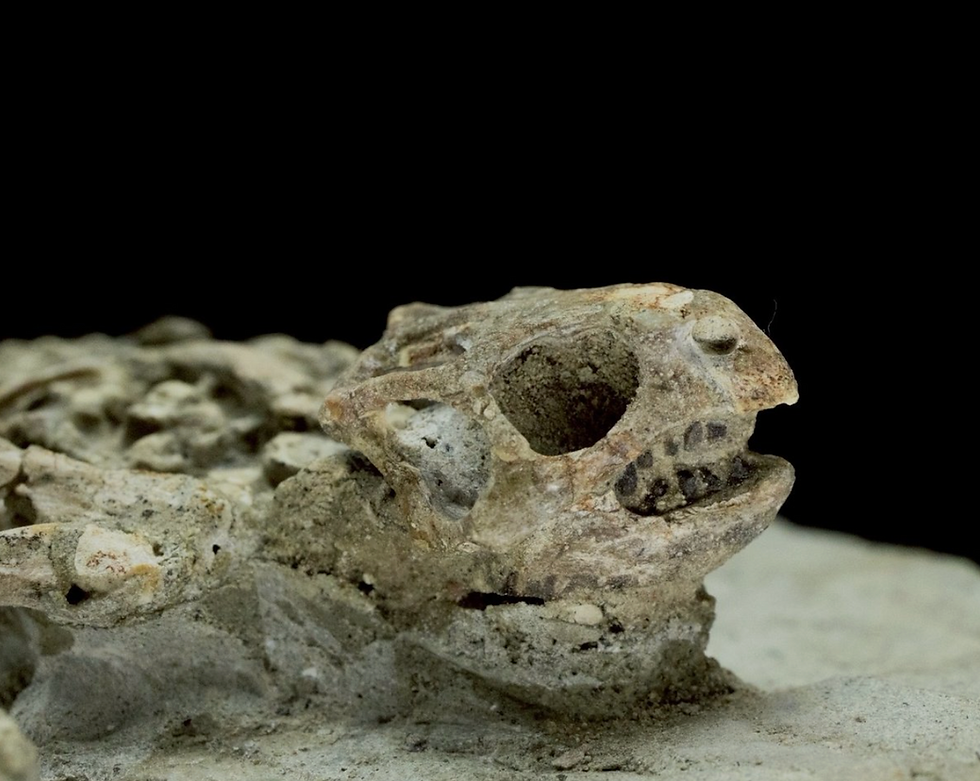
The Psittacosaurus, meaning “parrot lizard,” was a small, early ceratopsian dinosaur that lived in Asia during the Early Cretaceous, more than 100 million years ago. Recognized by its distinctive parrot-like beak and compact body, Psittacosaurus represents an important chapter in the early history of the ceratopsian dinosaurs.
Although very different in appearance from the later, imposing Triceratops, Psittacosaurus belonged to the same broader evolutionary group. Its anatomy provides an extraordinary glimpse into the early stages of a lineage that would eventually produce some of the most recognizable horned dinosaurs in Earth's history.

This Psittacosaurus skeleton offers a valuable window into the early evolution of ceratopsian dinosaurs. Its beak, skull structure, limbs, and proportions reveal adaptations that were already emerging early in the history of this diverse group. Studying specimens such as this helps researchers trace how ceratopsians changed over tens of millions of years, from relatively small, lightly built dinosaurs into the much larger and more specialized forms that appeared later.
Psittacosaurus was not a direct ancestor of Triceratops; rather, both belonged to the larger ceratopsian lineage and shared more distant ancestors. Triceratops appeared roughly 80 million years later, carrying the ceratopsian body plan to a remarkable new scale with its massive skull, horns, and broad frill. Together, these dinosaurs illustrate the extraordinary evolutionary diversity that developed within a single ancient lineage.
Preserved in stone, this skeleton represents an early chapter in that story a tangible record of the evolutionary experiments that shaped one of the most iconic groups of dinosaurs.
This Psittacosaurus skeleton offers a valuable window into the early evolution of ceratopsian dinosaurs. Its beak, skull structure, limbs, and proportions reveal adaptations that were already emerging early in the history of this diverse group. Studying specimens such as this helps researchers trace how ceratopsians changed over tens of millions of years, from relatively small, lightly built dinosaurs into the much larger and more specialized forms that appeared later.
Psittacosaurus was not a direct ancestor of Triceratops; rather, both belonged to the larger ceratopsian lineage and shared more distant ancestors. Triceratops appeared roughly 80 million years later, carrying the ceratopsian body plan to a remarkable new scale with its massive skull, horns, and broad frill. Together, these dinosaurs illustrate the extraordinary evolutionary diversity that developed within a single ancient lineage.
Preserved in stone, this skeleton represents an early chapter in that story a tangible record of the evolutionary experiments that shaped one of the most iconic groups of dinosaurs.